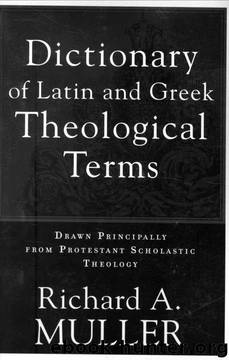
Dictionary of Latin and Greek Theological Terms: Drawn Principally from Protestant Scholastic Theology by Richard A. Muller
Author:Richard A. Muller
Language: eng
Format: epub
Published: 2009-11-17T23:40:00+00:00
lex Mosalca: Mosaic law; the moral law or lex moralis (q.v.) given to Israel by God in a special revelation to Moses on Mount Sinai. In contrast to the moral law known in an obscure way to all rational creatures, the lex Mosaica is the clear, complete, and perfect rule of human conduct. The Protestant scholastics argue its completeness and perfection from its fulfillment, without addition, by Christ. Since the law does promise life in return for obedience, the Reformed argue that in one sense it holds forth the abrogated foedus operum (q.v.), or covenant of works, if only as the unattainable promise of the righteous God and the now humanly unattainable requirement for salvation apart from grace. In addition, the Reformed can argue that Christ's perfect obedience did fulfill the covenant of works and render Christ capable of replacing Adam as federal head of humanity. Primarily, however, the Reformed view the law as belonging to the Old Testament dispensatio (q.v.) of the foedus gratiae (q.v.), or covenant of grace. It is the norm of obedience given to God's faithful people to be followed by them with the help of grace. As a norm of obedience belonging to the foedus gratiae, the law remains in force under the economy of the New Testament. Lutheran orthodoxy, which does not follow the covenant schema typical of the Reformed, also views the law as the perfect standard of righteousness and the absolute norm of morals, which requires conformity both in outward conduct and inward obedience of mind, will, and affections. In the Lutheran system, however, the law does not appear so much as an adjunct of the gospel as a standard over against the gospel and in dialectical tension with it. The law leads to Christ by humbling the sinner through its condemnation of evils rather than by being subsumed under the promise. This difference between the Lutheran and Reformed views is most apparent in the discussion of the use of the law, the uses legis (q.v.).
Download
This site does not store any files on its server. We only index and link to content provided by other sites. Please contact the content providers to delete copyright contents if any and email us, we'll remove relevant links or contents immediately.
Periodization Training for Sports by Tudor Bompa(8276)
The Body: A Guide for Occupants by Bill Bryson(5102)
The MacArthur Bible Commentary by John MacArthur(4829)
The Sports Rules Book by Human Kinetics(4395)
What It Really Takes to Get Into Ivy League and Other Highly Selective Colleges by Hughes Chuck(3765)
Marijuana Grower's Handbook by Ed Rosenthal(3689)
The Sprouting Book by Ann Wigmore(3595)
The Martian by Andy Weir(3431)
Salt, Fat, Acid, Heat: Mastering the Elements of Good Cooking by Nosrat Samin(3152)
Sapiens and Homo Deus by Yuval Noah Harari(3078)
Harry Potter 4 - Harry Potter and The Goblet of Fire by J.K.Rowling(3076)
The Bread Bible by Rose Levy Beranbaum(3073)
The Marketing Plan Handbook: Develop Big-Picture Marketing Plans for Pennies on the Dollar by Robert W. Bly(3067)
Classic by Mary Berry(3016)
Martha Stewart's Baking Handbook by Martha Stewart(2866)
Screenplay: The Foundations of Screenwriting by Syd Field(2647)
The Plant Paradox by Dr. Steven R. Gundry M.D(2627)
50 Economics Classics by Tom Butler-Bowdon(2578)
The Cambridge Grammar Of The English Language by Rodney Huddleston Geoffrey K. Pullum(2432)
